Crafting the Sound of Healing: Ember Health’s Partnership with Spiritune


Schedule Your Ketamine Therapy Consultation Today
At Ember Health, we’ve long known that music is a central detail in the IV ketamine experience. For many patients, it becomes the container that holds the session: the mechanism that supports safety, helps emotions move, and gives shape to an experience that is otherwise largely internal. Over time, we’ve heard time and again from patients that music matters deeply, and they wanted more options that felt intentionally designed for this kind of work.
That feedback sharpened our sense that something was missing in the broader landscape of psychedelic therapy playlists. Many commonly used playlists are assembled intuitively. Some lean heavily ambient, some rely on orchestral or classical music, and others incorporate familiar songs with lyrics. While each of these approaches can be beautiful, they don’t necessarily align with the arc of IV ketamine treatment or with what patients describe needing in the room.
In particular, we heard that looping short ambient tracks could unintentionally create stagnation. When a five-minute piece repeats over and over, some patients experience a kind of circularity in their thoughts, and a sense of being stuck rather than gently guided forward.
When we began looking for a music collaborator, we weren’t simply searching for beautiful sound, but rather music built for purpose:
- Non-lyrical and low-distraction
- With a clear narrative arc
- Aligned with the pharmacological arc of the medicine
- Designed with emotional intentionality
- Rooted in neuroscience and evidence
That search led us to Spiritune.
An Evidence-Based Approach to Music and the Mind
Spiritune, founded by Jamie Pabst, is a therapeutic music platform that combines principles of music therapy and neuroscience to create music from the ground up. Rather than curating existing songs, Spiritune designs compositions intentionally, guided by research on how rhythm and tone interact with the brain and body.
Spiritune works across both wellness and clinical settings, personalizing music to align with emotional and cognitive needs. In partnership with clinical teams like Ember’s, that personalization maps music not just to a mood, but to a therapeutic context.
In partnership with Ember Health, Spiritune has created four bespoke 50-minute tracks designed specifically for the IV ketamine experience. Each track aligns with one of four emotional states that we aim to support in our care model:
- Calming
- Uplifting
- Centering
- Grounding
The Spiritune team has carefully constructed four distinct musical containers designed to support personalized internal experiences, and gently guide versus distract the patient’s own mental journey. To understand why this level of design matters, it helps to look at what music is actually doing in the brain.
The Biology of Music: Why It Moves Us
One of the most important discoveries in music neuroscience is that music activates the brain’s reward circuitry— an ancient and highly conserved pathway involved in motivation, pleasure, learning, and reinforcement.
When someone listens to music they enjoy, that reward pathway couples with the hypothalamus, a master regulator of the body’s internal state. This coupling helps explain why music can have measurable physiological effects. The hypothalamus regulates:
- Autonomic nervous system balance
- Cardiovascular function
- Metabolism and digestion
- Inflammation
- Hormonal stress responses (including cortisol release)
- Endorphin release (affecting pain and pleasure)
- Oxytocin release (supporting connection and bonding)
Music also activates the amygdala, which plays a key role in emotional salience— how the brain determines what feels meaningful, safe, threatening, or important. During ketamine sessions, when emotional material can surface with heightened intensity, music can shape the emotional tone of the experience by modulating these systems.
Beyond reward and emotion, music engages:
- Motor planning regions (even when we don’t physically move)
- Interoceptive networks (awareness of internal bodily states)
- Memory systems
- Integrative brain regions that weave together thought, feeling, and relevance
Because music touches so many systems at once, it becomes uniquely powerful during altered states of consciousness.
Rhythm: A Uniquely Human Capacity
At the foundation of music are two biological capacities: rhythm and tone.
Humans possess a remarkable ability to synchronize with rhythmic cycles. Even when instructed not to move, brain imaging shows that motor centers activate in response to groove and beat. Our brains naturally track overlapping cycles of sound, creating an internal sense of momentum.
Interestingly, this rhythmic ability is rare across the animal kingdom. Most animals cannot flexibly synchronize to a beat. A notable exception is parrots, which, like humans, can adjust to changes in tempo. Researchers believe this ability is linked to strong auditory–motor coupling, a feature closely connected to the evolution of speech.
Because humans evolved to tightly couple what we hear, with what we can produce vocally, music is able to engage those systems directly. In a ketamine session, rhythm can:
- Create forward movement during the ascent of the medicine
- Provide containment during emotionally intense moments
- Support regulation of internal pacing
- Reinforce a sense of groundedness and safety
Even in stillness, rhythm activates the body’s readiness systems.
Tone: The Biology of Emotional Cadence
Tone—the pitch and contour of sound—has even deeper evolutionary roots.
In nature, tones are primarily produced by animals to communicate. Human vocal tone is inseparable from emotional expression. We can hear sadness, joy, tension, or calm in someone’s voice even without understanding their words.
This system is ancient and physiologically embedded. When someone feels depressed, their vocal pitch range often narrows. When someone feels energized or joyful, their tone becomes more animated and dynamic. From the womb, we begin attuning to tonal and rhythmic qualities of a caregiver’s voice. By birth, we already have strong neural coupling between sound, emotion, and reward.
Music leverages this system without needing language. That’s why Spiritune’s compositions are non-lyrical. Lyrics recruit language networks and can pull attention outward. In contrast, carefully structured tone and harmony can communicate emotional cadence while leaving room for the patient’s internal narrative.
Ascending melodic contours often feel uplifting. Stable harmonies can evoke safety. Lower-frequency textures can feel grounding. Subtle shifts in timbre can convey warmth, brightness, or resolve.
Because tone is biologically tied to emotion, it becomes a powerful tool in shaping the felt sense of a session.
Designing Four Emotional States for Ember
In collaboration with Spiritune, we identified four emotional states that frequently arise in treatment and explored what they truly mean in felt experience.
With this guidance, the Spiritune team custom-crafted four distinct tracks of music that we can play for our patients in-office to guide their treatment experience. Each piece of music incorporates slightly different features related to the emotional state it is designed to support.
Below, we’ve outlined some of the concepts that guided the crafting of these pieces, and the musical elements that the Spiritune team used to support each piece.
1. Grounding
Rooted. Safe. Held.
Our Grounding composition:
- Incorporates heartbeat-like rhythms to help the listener feel safe and held
- Incorporates sounds of the ocean which mimics in-utero sounds, again creating a sense of being held
- Uses warm, mid-range string instruments which are stabilizing against feelings of drift
- Builds on clear and engaging rhythms to help listeners stay rooted
The intention is to create containment and rootedness while still allowing the journey to unfold.
2. Calming
Relaxed. Peaceful. Gentle.
Our Calming composition:
- Incorporates a mellower and lower-intensity rhythm for emotional calm and steadiness
- Incorporates higher tones like bells and chimes played with subtle syncopation that supports the groove while also being relaxing
- Includes mallet instruments like marimbas that have soft yet full sounds that help with higher frequency anxiety, naturally slowing down the breath and heart beat
This track is designed to support parasympathetic regulation and emotional softening.
3. Centering
Resolute. Focused. Triumphant.
The Centering composition:
- Includes heartbeat rhythms to help bring people back to their own center
- Weaves in Eastern instruments (like tabla and sitar) that have a clear sharpness that help to snap negative or intrusive thought loops
- Builds in higher human voice timbres (though no lyrics) that create sense of connectedness
- Incorporates nature sounds to provide a centering connectedness to nature and the broader world
The goal is to support clarity, integration, and a sense of internal alignment.
4. Uplifting
Joyful. Bright. Inspired.
The Uplifting composition:
- Includes handpan and higher pitched chimes that elicit feelings of joy and freedom
- Incorporates timbres of the human voice that taps into feelings of joy and optimism
- Included sounds of water to help alleviate feelings of heaviness, and create more movement
These elements can evoke expansion, possibility, and emotional lightness.
Mapping Music to the Medicine Arc
Unlike typical shorter tracks, each of these compositions spans approximately 50 minutes, mirroring the arc of IV ketamine treatment. Each track begins gently at the onset, gradually builds as the medicine builds, includes a peak of musical and emotional intensity, and then tapers towards resolution as the medicine metabolizes. This musical “narrative arc” can be seen in the musical progression of the grounding track below.
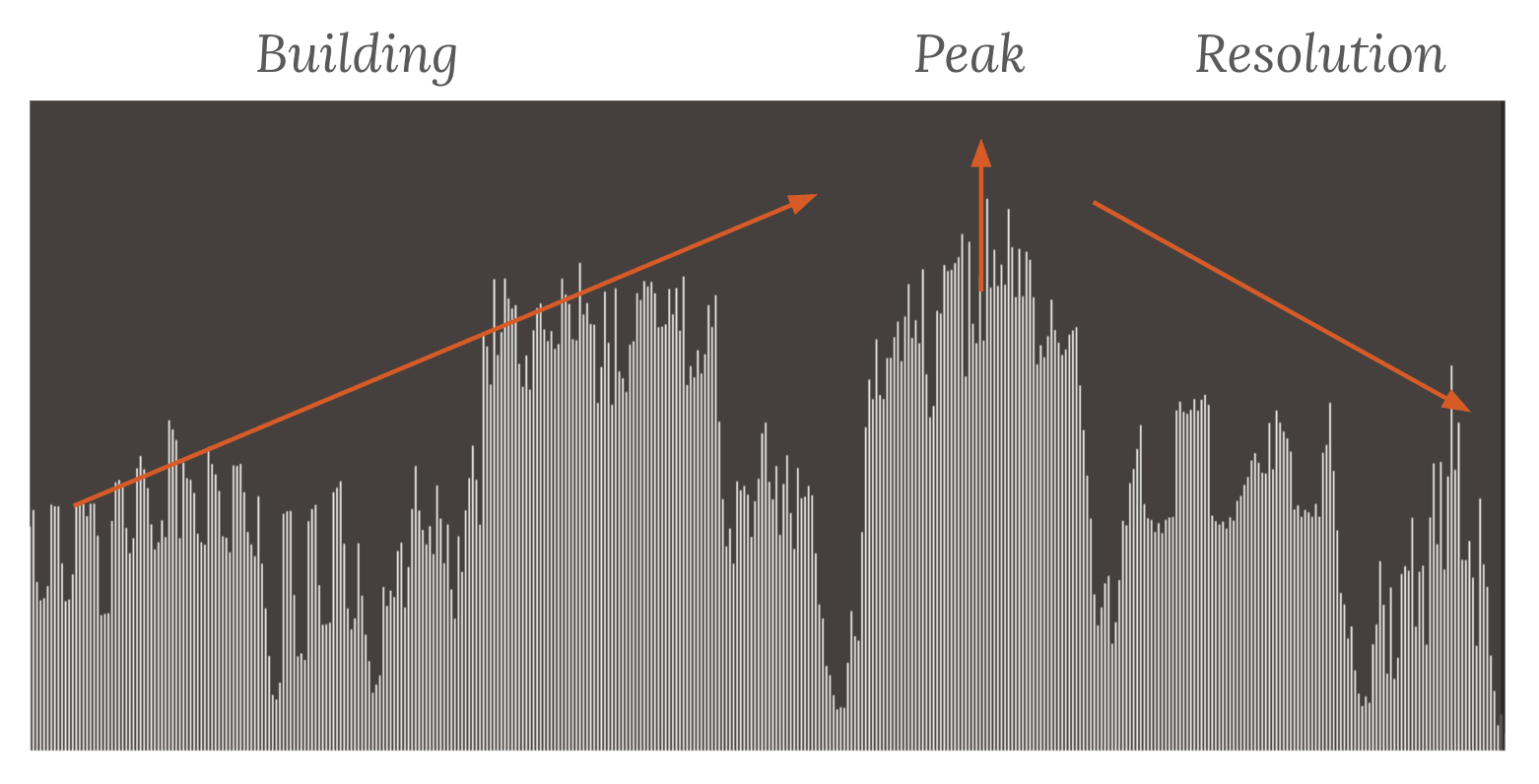
The intention of the music is to provide structure without dominating attention. It offers a baseline emotional trajectory while leaving room for the patient’s own internal process.
We are also offering two versions of each track: a pure music version and one that begins with a brief guided meditation. This meditation was inspired directly by patient feedback, as many first-time patients ask what to do once they close their eyes. We’ve established a short, gentle visualization and breathing prompt to help anchor intentions without imposing a narrative.
What We Hope to Learn
One of the most exciting aspects of this partnership is the opportunity to study its impact. Spiritune and Ember share a commitment to evidence-based care, and this collaboration is designed not just to enhance experience, but to generate learning.
We will be partnership with Stanford University’s Music, Brain, and Health Lab to collect and analyze both quantitative and qualitative data. Key research questions include:
- Do different tracks correlate with changes in PHQ outcomes?
- Are there differences in remission or treatment response rates?
- Does bespoke music influence the frequency of psychologically challenging experiences?
- Are clinician interventions reduced when sessions are paired with custom tracks?
- Are there measurable changes in physiological events related to anxiety or autonomic stress?
- What themes emerge in patient-reported experiences of the music?
We recognize that detecting statistically significant differences in already strong clinical outcomes may require large sample sizes. However, even small insights into experiential quality and session stability could meaningfully inform care.
A Shared Commitment to Thoughtful, Evidence-Based Care
At Ember Health, we believe that thoughtful attention to even the smallest detail of care matters. This includes the lighting in the room, the words spoken before the infusion, the integration conversation afterward, even the way we help our patients put on and take off their headphones and eye mask, let alone the music that guides the subconscious mind through an infusion.
Music is not incidental in IV ketamine therapy. It interfaces directly with the reward system, the amygdala, the hypothalamus, motor networks, and memory systems. It shapes stress, pain perception, emotional salience, and internal pacing. We believe it has the power to anchor, uplift, soothe, and steady.
Our partnership with Spiritune reflects a shared commitment to bringing rigor, intentionality, and science into every layer of care. Together, we are not only offering a more thoughtfully designed soundscape, we are studying how music and medicine interact, with the hope of continually refining the patient experience.
We’re excited to see what we learn, and even more excited to offer our patients music crafted with as much care as the medicine itself.
We provide evidence-based IV ketamine treatment for depression, anxiety, and other mental health conditions. Schedule a free consultation call to learn more.
- Brooklyn Heights
- Chelsea
- Tribeca
- Upper East Side
- Williamsburg